The “Hidden Cost” of Industrial Illumination
If you manage or own a factory, warehouse, or manufacturing plant in India, lighting is almost certainly not your primary concern. You have production targets, machinery uptime, and supply chains demanding your attention. Lighting, when it works, disappears into the background.
The problem is that when industrial lighting is specified incorrectly, it doesn’t just drain energy – it creates a ripple effect of hidden costs. Poorly diffused light leads to worker fatigue, missed quality control defects in assembly lines, and safety risks in material handling zones with deep shadows. In 2026, lighting is no longer just a utility; it is a precision engineering component of your facility’s ROI.
1. Decoding the Ceiling Height vs. Beam Angle Equation
High-bay lighting is defined by application, not just wattage. The most common mistake in Indian warehouses is ignoring the relationship between mounting height and light concentration.
- For 6m – 9m Ceilings: You are looking at a “Low-Bay” application. Wide beam angles (90° to 120°) are generally preferred here to ensure light overlaps properly before hitting the floor, eliminating dark spots between aisles.
- For 12m – 20m+ Ceilings: This is high-stakes lighting. Using a wide beam angle at 15 meters is like using a garden hose to try and hit a target 50 feet away—the light “sprays” and loses intensity before it reaches the floor. Here, narrow beam angles (30° to 60°) act like a spotlight, punching through the height to deliver high lux levels exactly where your workers need them.
The Economic Advantage: Correct beam angle selection often means you can achieve the same lux level with a 200W fixture that your competitor is struggling to reach with a 300W fixture. That is a direct 33% saving on your monthly electricity bill.
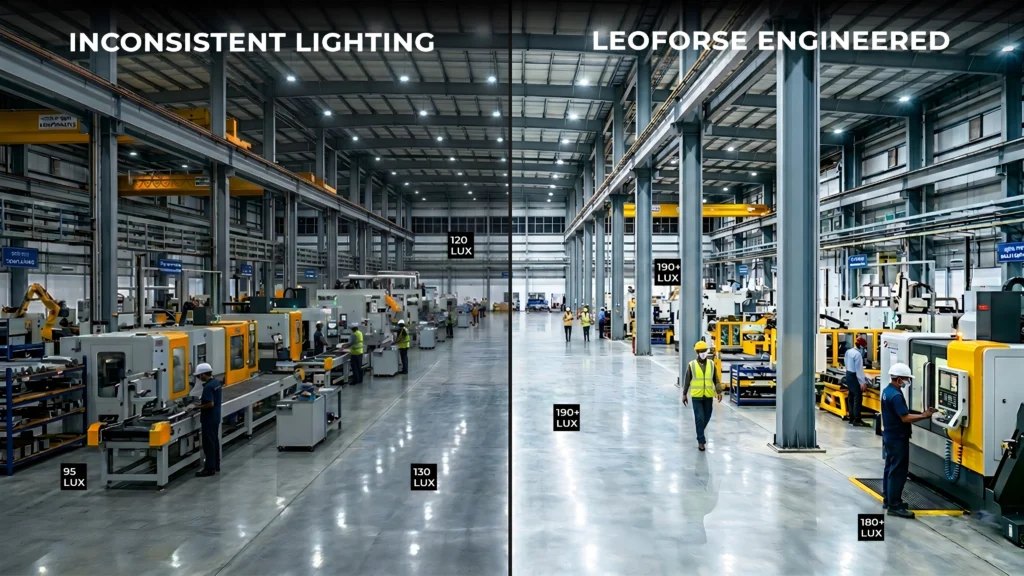
2. Lux Standards & The Science of Uniformity
Lux is the measurement of light intensity on a surface. In India, the National Building Code (IS 3646) provides clear benchmarks, but most owners stop at “is it bright?” without checking for Uniformity (Emin/Eave).
A facility with 500 lux directly under the lamp but only 50 lux between lamps has a terrible uniformity ratio. This causes the human eye to constantly adjust as workers move through the space, leading to headaches and decreased productivity.
| Space Type | Recommended Lux | Optimal Uniformity Ratio |
| Heavy Fabrication | 300 – 500 Lux | 0.60 |
| Precision Assembly | 500 – 1000 Lux | 0.80 |
| General Warehousing | 150 – 200 Lux | 0.40 |
| Loading Docks | 150 – 300 Lux | 0.50 |
3. The Physics of Heat: Why “Generic” LEDs Fail in India
LED performance is fundamentally a thermal engineering problem. The light-emitting junction inside an LED chip degrades permanently if it gets too hot.
In a South Indian factory where ambient temperatures hit 45°C, the air near the ceiling can reach 55°C or higher. A standard LED fixture with a thin, stamped-metal housing cannot dissipate this heat fast enough. This leads to “Thermal Lumen Depreciation”—the light permanently dims after just 18 months.
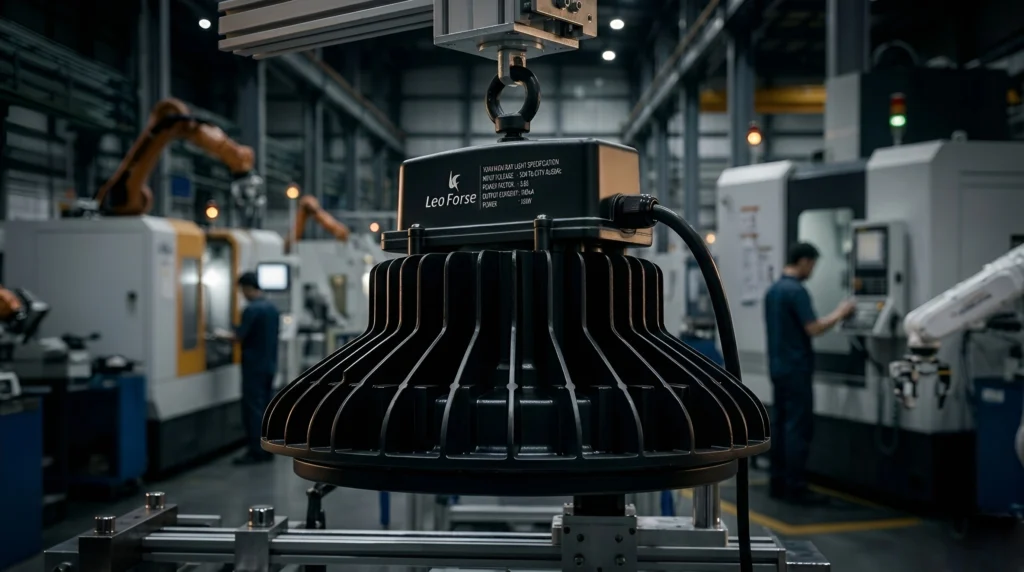
At Leoforse, we solve this with high-density aluminum extrusion heat sinks. By increasing the surface area for cooling, we keep the junction temperature within the safe zone, ensuring that your 50,000-hour rated lifespan is a reality, not a theoretical lab number.
4. Grid-Resilient Electronics (The 10KV Standard)
The Indian industrial grid is notoriously “noisy.” When a 50HP motor kicks in or a transformer switches, it sends a high-voltage transient through your wiring.
Standard commercial LED drivers are rated for 2KV to 4KV surges. In an industrial setting, these surges will eventually puncture the driver’s insulation, causing “flicker” or total failure. By specifying 10KV Surge Protection, you aren’t just buying a light; you are buying an insurance policy for your infrastructure. It is the difference between a lighting system that lasts 3 years and one that lasts 12 years.
5. The Efficiency of Custom Wattage Tuning
Most manufacturers force you to choose between 100W, 150W, or 200W. This is for their inventory convenience, not your efficiency.
Imagine a Dialux simulation shows that to hit 300 lux in your facility, you need exactly 172 Watts per fixture.
- If you buy 150W, you are under-lit and unsafe.
- If you buy 200W, you are wasting 28 Watts per fixture every single hour.
In a facility with 100 fixtures running 12 hours a day, that 28W overshoot adds up to over 12,000 kWh of wasted energy per year. We provide custom-tuned wattages to match the engineering simulation, ensuring you pay for exactly the light you need no more, no less.
Expert FAQ: Designing for Longevity
Q: How do I know if my current lighting is inefficient?
If you see “yellowing” of the lenses or if your light levels have visibly dropped since installation, your fixtures are suffering from thermal degradation. An onsite lux audit can confirm your current efficiency versus 2026 standards.
Q: What is the benefit of 0-10V or DALI dimming in a factory?
It allows for “Daylight Harvesting.” If your warehouse has skylights, sensors can automatically dim the LEDs when sunlight is sufficient, slashing energy costs by up to 40% during day shifts.
Q: Why is BIS certification so important for my audit? BIS (Bureau of Indian Standards) ensures that the product meets specific safety and performance benchmarks (IS 10322). For ISO-certified companies, using non-BIS lighting can be a major compliance risk during safety audits.
The Question for Your Next Operations Meeting
“If we saved 30% on our lighting energy and eliminated maintenance for the next decade, where could that capital be better reinvested in our production line?”
Drop a comment below with your factory’s ceiling height. Our engineering team will give you a quick tip on the ideal beam angle for your specific layout.
Conclusion: Scaling with Engineering Precision
Industrial lighting is a long-term capital investment. By moving away from “box-buying” and toward an engineered approach – focusing on beam angles, thermal management, and grid resilience – you upscale your facility’s performance and your brand’s credibility. Don’t just buy a light; install a solution that grows with your business.
Stop Guessing. Start Engineering.
Leoforse provides end-to-end photometric support for Indian industries.
Consult Our Technical Lead: +91 95005 78101
0 Comments