
Every municipal body, EPC contractor, and township developer in India asks this question. And almost all get the answer wrong – because they are asking the wrong version of it. It is not which is better. It is which is right for this specific site, this grid condition, and this lifecycle budget. When evaluating Solar or Grid Street Lighting, this is the complete technical comparison that actually answers it.
THE CORE DISTINCTION
Two Modern Systems. Two Different Engineering Problems.
Both solar-powered LED street lighting and grid-connected LED street lighting use high-efficacy LED modules to optimize total energy consumption. This comprehensive comparison guide is designed to map out those exact operational parameters cleanly. in IP66-rated die-cast aluminium housings. Both can achieve identical photometric performance on the road surface.
The difference is in the energy supply architecture – and that difference has cascading implications for capital cost, operating reliability, maintenance requirements, and the correct application environment.
💡 THE CORE PRINCIPLE
Solar is an energy harvesting and storage system with an LED output. Grid-tied is an LED system with utility power input. Both are valid modern infrastructure technologies. The site determines which is right – not a preference, not a trend.
How Each System Is Actually Built
Grid-Tied LED Street Lighting
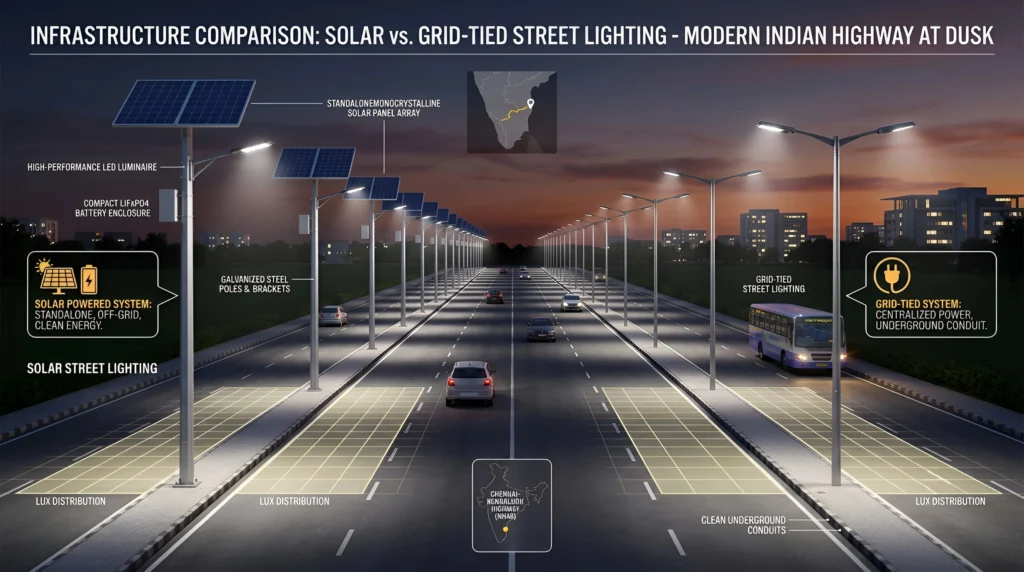
When mapping out Solar or Grid Street Lighting configurations, a grid-connected system draws power from the utility network through a feeder pillar. Individual poles carry LED luminaires connected via underground cabling. Smart controls dimming schedules, fault monitoring, central management are implemented via DALI or wireless protocols on a Central Management System (CMS). This architecture relies on continuous, balanced AC voltage supply from local distribution transformers, ensuring long-term system reliability across the entire municipal grid network.
Solar LED Street Lighting
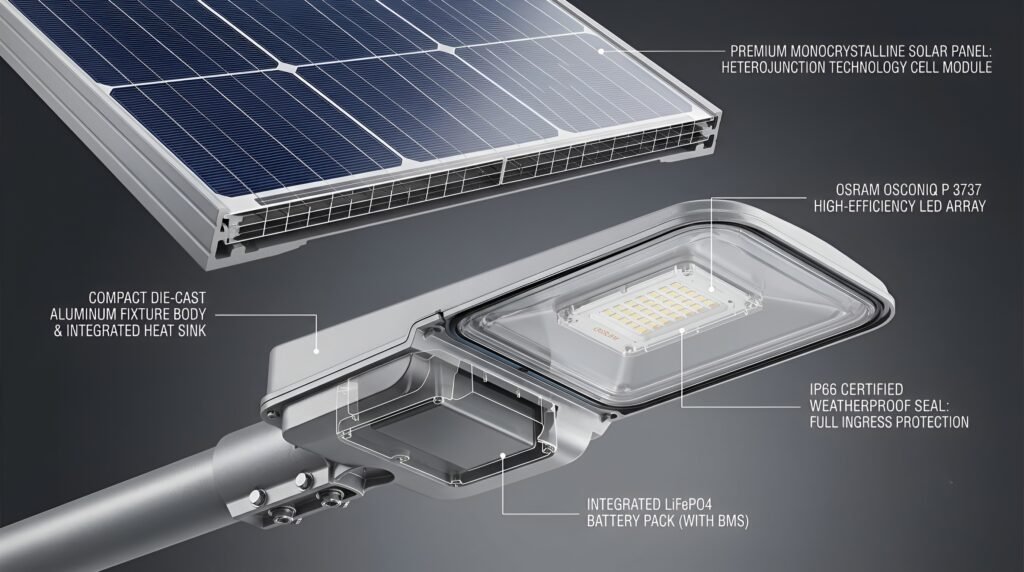
Alternatively, in the Solar or Grid Street Lighting debate, a solar street light stands completely as a self-contained system at each pole. A monocrystalline panel harvests daylight. An MPPT (Maximum Power Point Tracking) charge controller optimises energy conversion and charges a LiFePO4 battery. The LED luminaire draws from the battery under dusk-to-dawn control with adaptive dimming to extend autonomy through low-solar periods. This configuration functions entirely as an independent DC micro-grid on every single pole.
The Complete Comparison for Indian Conditions
| Parameter | Solar LED Street Light | Grid-Tied LED Street Light |
| Capital Cost per pole | Higher – panel, battery, MPPT included | Lower – luminaire and cable only |
| Operating Cost | Near-zero electricity cost | Monthly utility tariff per unit |
| Grid Dependency | Fully off-grid capable | Requires reliable utility supply |
| Battery Replacement | LiFePO4: 8–10 year cycle | Not applicable |
| Power Cut Vulnerability | Unaffected by outages | Fails during power cuts |
| Urban Dense Installation | Less suitable – shading, aesthetics | Preferred – cleaner install |
| Remote or Rural Roads | Ideal – no grid extension cost | Grid extension can be prohibitive |
| Smart Control Options | Adaptive dimming, GSM monitoring | Full DALI, CMS, real-time faults |
| Monsoon Performance | Panel output reduced – battery depth matters | Unaffected by weather |
| 10-Year Lifecycle Cost | Lower in off-grid or high-tariff areas | Lower where grid is stable and cheap |
DEEP-DIVE ENGINEERING ANALYSIS
Photometric Uniformity and Structural Dynamics
When evaluating Solar or Grid Street Lighting, engineers must look past basic wattage ratings and evaluate real-world lumen output and beam distribution. Under Indian Standard IS 1944, public roadways demand strict lux uniformity ratios to eliminate dangerous “zebra patterns” alternating dark and bright spots on the tarmac that strain drivers’ vision.
Uniformity Ratio (U0) = Minimum Lux / Average Lux
Target Benchmark: U0 >= 0.40 for major thoroughfares
While grid-tied infrastructure supplies an unyielding stream of alternating current to maintain constant lumen output all night, solar fixtures rely on intelligent internal logic. During monsoon seasons or prolonged cloud cover across regions like North-Eastern India, incoming solar irradiance can plummet by over 60%. To maintain safety thresholds without draining the battery storage below critical depths, state-of-the-art MPPT controllers employ dynamic, pulse-width modulation (PWM) dimming profiles.
Furthermore, structural calculations present vastly divergent challenges:
- Grid Poles: Deal primarily with linear wind loads based on the pole’s circular or octagonal cross-section profile.
- Solar Poles: Act as large vertical sails. A 100W monocrystalline solar panel introduces a substantial surface area at a high center of mass. For locations in coastal zones like Puducherry or Chennai, these poles must undergo rigorous wind-tunnel simulations to withstand gust velocities up to 180 km/h without structural deflection or anchoring failure.
The Four Questions That Select the Right System
Question 1: Is the grid reliable at this location?
When deciding on Solar or Grid Street Lighting for urban municipalities with grid uptime above 95%, grid-connected LED street lighting delivers lower total cost of ownership and better smart-control capability. In rural areas or locations with outages exceeding 4 hours per night, solar removes the outage vulnerability entirely.
Question 2: What is the cost of grid extension?
When surveying sites for Solar or Grid Street Lighting, road sections more than 500–800 metres from an existing feeder pillar make grid extension cost-prohibitive, underground cable costs, trenching, and civil excavation can make the grid option significantly more expensive in capital terms than solar – before factoring in electricity running costs over 10 years.
Question 3: What is peak sun availability at this location?
When evaluating Solar or Grid Street Lighting metrics, Southern India receives 5 to 5.5 peak sun hours per day – making it exceptionally well suited for solar deployments.. North-eastern India and hilly regions may see 3.5 to 4.5 hours, demanding larger panel sizing and deeper battery capacity for reliable all-night performance.
Question 4: What is the 10-year total cost of ownership?
A complete financial evaluation of Solar or Grid Street Lighting requires calculating: grid capital plus 10 years of electricity tariff vs solar capital plus one battery replacement vs solar capital plus one battery replacement plus maintenance. In most off-grid or high-outage scenarios, solar TCO over 10 years is lower. In stable urban grids with low tariffs, grid-connected TCO is typically lower.
FINANCIAL LIFECYCLE FORECASTING
Capital Expenditure vs. Operational Expenditure
Procurement executives are frequently caught in the trap of focusing solely on upfront purchase costs. A true infrastructure-grade deployment requires a thorough 10-year Net Present Value (NPV) calculation to compare the actual cost of cash outflows over time, allowing stakeholders to evaluate the pros and cons of front-loaded capital vs. recurring operational expenses.
Let’s break down the hidden variables that alter the balance sheet:
Total Cost of Ownership (TCO) = CapEx + Sum(OpEx_Years_1_to_10) + Lifecycle Maintenance
- The Grid Ledger: Evaluating the grid path for Solar or Grid Street Lighting reveals that CapEx is lower because you are purchasing basic luminaires and structural poles. However, the operational side includes permanent monthly electricity tariffs, continuous line-loss degradation across copper cabling, and the recurring cost of replacing external surge protection devices (SPDs) after volatile monsoon lightning strikes.
- The Solar Ledger: Choosing the solar route for Solar or Grid Street Lighting means your upfront CapEx is heavily front-loaded due to the cost of premium Lithium Iron Phosphate (LiFePO4) storage arrays and high-purity silicon panels. But once deployed, the operational energy tariff drops to absolute zero. The primary lifecycle cost event occurs between year 8 and year 10, when the electrochemical capacity of the battery naturally degrades and requires a field replacement.
What Leoforse Delivers for Both Solar or Grid Street Lighting Infrastructure Systems
| Product | Power Range | Key Specs | Application |
| Solar Street Light | 20W – 100W | LiFePO4, MPPT, 110 lm/W+, dusk-to-dawn adaptive dimming | Rural roads, highways, eco-townships, remote sites |
| LED Street Light | 24W – 300W | IP66, >6KV surge, 90V–300V wide input, OSRAM LED | Urban roads, smart city projects, highways, campuses |
| High-Mast LED | Customized – Ultra-high power | IP66, OSRAM modules, asymmetric optics, 12m–30m poles | Interchanges, industrial yards, ports, stadiums |
| Octagonal Poles | 5m – 25m | Hot-dip galvanised steel, heavy-duty base plate | Complete turnkey street lighting supply |
Leoforse offers a comprehensive range of customized lighting solutions designed to meet diverse application needs and solve real-world challenges.
- ✓ Site over Preference: Solar and grid-tied are both valid modern technologies site conditions determine the correct choice.
- ✓ The Urban Choice: Grid-connected LED is preferred where utility power is reliable, tariff is low, and CMS control is needed.
- ✓ The Rural Edge: Solar LED is preferred for remote sites, high-outage areas, and where grid extension cost is prohibitive.
- ✓ Infrastructure Chemistry: LiFePO4 battery is the only recommended chemistry for infrastructure-grade solar 8–10 year cycle life.
- ✓ True Cost Metrics: 10-year total cost of ownership – not unit capital cost – is the correct financial comparison metric.
- ✓ The Leoforse Advantage: Leoforse supplies both systems: IP66, BIS-certified, surge-protected, 20W to 300W+.
Analyzing these architectural variances makes evaluating Solar or Grid Street Lighting simple for field procurement teams.
CONCLUSION
The solar-versus-grid debate in Indian street lighting has produced more bad procurement decisions than almost any other question in the sector because it is framed as a technology preference rather than a site engineering question. Both systems, correctly specified, are excellent. A solar system on a sun-rich rural road where grid extension costs are prohibitive is the obvious right choice. A grid-connected system on a busy urban boulevard with reliable power and CMS-managed dimming is equally obvious.
Because Leoforse manufactures engineering-grade solutions for both Solar or Grid Street Lighting layouts, our engineering team is available to run your site-specific analysis, photometric simulation, and TCO calculation for your project at no cost. The right system exists. The question is which one is right for your site.
OVER TO YOU
Which side of the Solar or Grid Street Lighting spectrum fits your current project? Which type of road or location are you lighting? Is grid reliability a challenge at your site? Share the details ! our team will recommend the right system for your specific conditions.
Comment below – our engineering team replies to every question.
FAQ
Solar or Grid Street Lighting — Technical FAQ Quick Answers
Q: Can solar street lights really run all night in India?
A: Yes – with correctly sized systems. A well-engineered solar street light for Indian conditions uses a panel sized for the lowest peak sun hours in the target region, a LiFePO4 battery with capacity for 2–3 consecutive cloudy nights, and adaptive dimming to manage battery depth during extended low-solar periods.
Q: What maintenance does a solar street light require?
A: Primary tasks: panel cleaning to manage dust accumulation, MPPT controller inspection, and battery capacity monitoring. Battery replacement is the main lifecycle cost event at years 8–10 for LiFePO4 systems. Grid LED luminaires require driver replacement typically every 5–8 years for quality products.
Q: Are Leoforse street lights BIS certified?
A: Yes. Leoforse LED street lights are BIS certified and manufactured in an ISO 9001:2015 certified facility in Puducherry. BIS certification is required for government road projects and municipal procurement in India.
Q: Can I get poles from Leoforse along with luminaires?
A: Yes. Leoforse supplies hot-dip galvanised octagonal poles from 5m to 25m, compatible with both solar and grid-connected LED luminaires, for complete turnkey street lighting procurement.

0 Comments