
Conducting an industrial lighting audit reveals that most Indian factory owners have no idea what their lighting is actually costing them – not just in electricity, but in lost productivity, failed audits, and fixtures that should have been replaced two years ago. A professional lighting audit fixes all of that in a single session. Here is exactly how it works, what it reveals, and why the numbers almost always surprise people.
WHY AUDITS MATTER
The Silent Drain in Every Factory That Nobody Measures
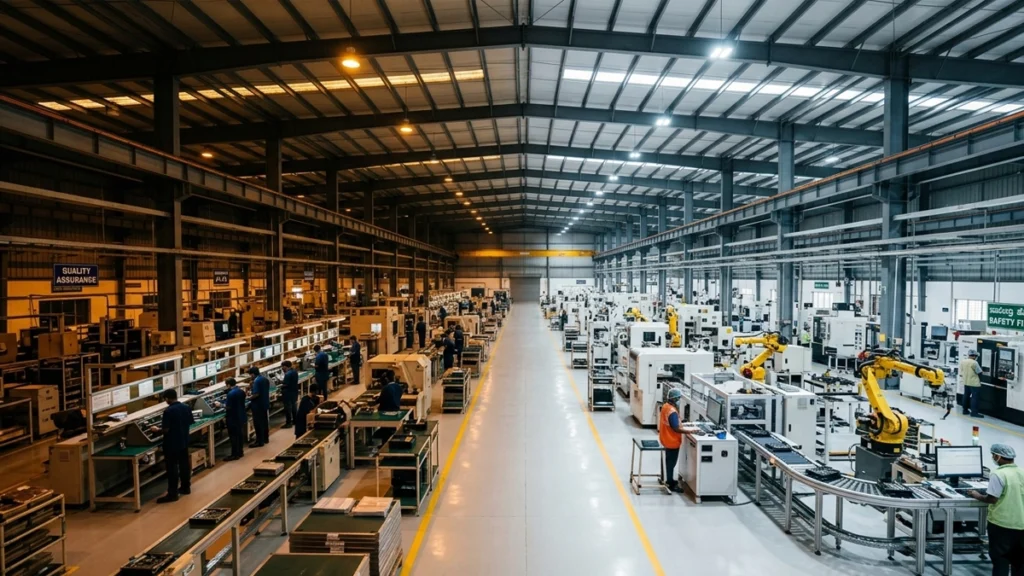
When launching an industrial lighting audit, there is a number that lives somewhere in your operating costs that nobody questions. It shows up every month on the electricity bill. It quietly inflates your overheads. And if you have never conducted a formal lighting audit, there is a good chance that number is significantly higher than it should be.
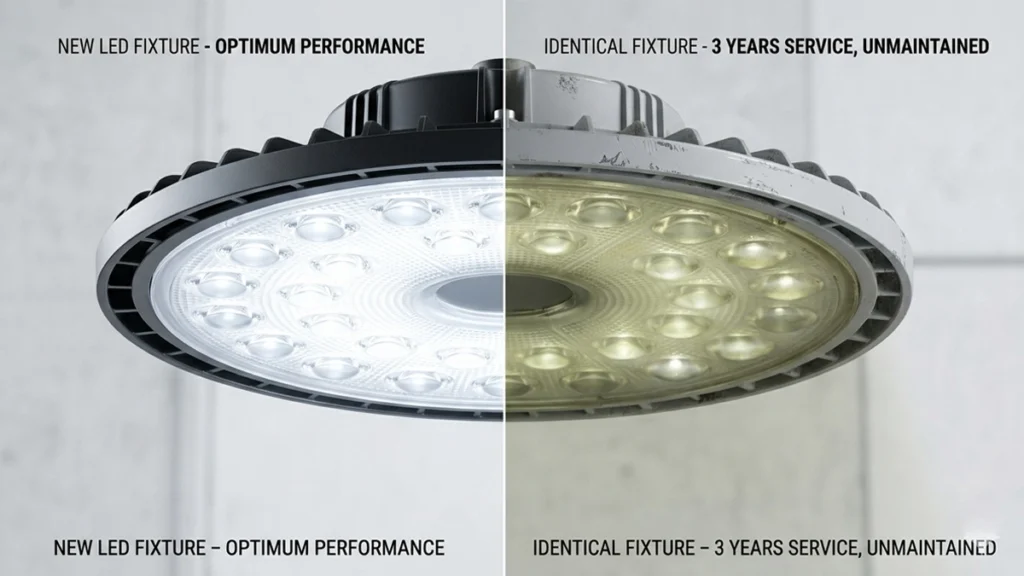
More important than energy cost: an unaudited lighting system is a safety compliance liability. Lux levels degrade silently as LED chips age and drivers weaken. The assembly line correctly lit at commissioning may be running 30% below its specified lux level three years later – and nobody noticed because the decline was gradual.
- 30% – Average Lux Drop in Unaudited Systems After 3 Years
- FREE – Leoforse Audit and Simulation Service
- 48hr – Audit Report Delivery Turnaround
STEP-BY-STEP PROCESS
How a Professional Industrial Lighting Audit Works
A lighting audit is a structured, zone-by-zone measurement of your facility against its IS 3646 compliance requirements and original lux specification. It captures the gap between what your lights should deliver and what they are delivering today.
- Step 1 — Zone Classification and Benchmark Assignment: Every zone is classified by task type – assembly, storage, inspection, corridor, loading and the IS 3646 minimum lux target is assigned per zone. This creates the benchmark against which every measurement is compared.
- Step 2 — Lux Measurement Grid: A calibrated lux meter records illuminance at working plane height in a grid pattern across each zone. Minimum, maximum, and average lux values are captured. The uniformity ratio is calculated from these readings.
- Step 3 — Fixture Condition Assessment: Every luminaire is inspected for lumen depreciation, housing damage, driver status, and IP integrity. Yellowing diffusers, flickering output, and corrosion on housing seams are the primary failure indicators.
- Step 4 — Energy and Efficacy Analysis: Installed wattage is compared against measured lux output to calculate real-world luminous efficacy. Zones where high wattage produces poor lux results are priority retrofit candidates.
- Step 5 — Photometric Modelling for Recommendations: Audit findings feed directly into a Dialux simulation that models the recommended replacement specification – fixture count, wattage, beam angle, spacing for each zone. You see post-retrofit lux levels before a single fixture is replaced.

AUDIT OUTPUT
Four Finding Categories Every Factory Audit Uncovers
| Finding Category | What It Reveals | Recommended Action |
| Lux Deficiency Zones | Areas below IS 3646 minimums | Fixture upgrade or supplementary lighting |
| Uniformity Failures | High peak, low minimum lux ratio | Beam angle correction or redistribution |
| Lumen Depreciation | Fixtures below 70% initial output | Scheduled replacement programme |
| Driver Near-Failure | Flickering, warm housing, voltage issues | Priority replacement – safety risk |
| Over-Lit Zones | Lux far above target – energy waste | Dimming controls or lower wattage |
WHAT YOU DISCOVER
The Three Things Every Factory Owner Finds
- You Are Paying for Light That Is Not Working
In most facilities without prior optimisation, between 20% and 35% of installed wattage is producing light that either misses the working plane, exceeds the required lux wastefully, or is consumed by degraded fixtures delivering 50% or less of rated output. - Your Compliance Exposure Is Real
IS 3646 and the National Building Code set minimum lux requirements for occupied industrial spaces. An inspection or insurance assessment that finds your facility below these thresholds creates legal and operational exposure. An audit quantifies exactly where you stand – before anyone else does. - The Retrofit Investment Pays Back
Post-audit retrofit projects that replace degraded, misspecified, or over-wattage fixtures with correctly specified LEDs consistently reduce lighting energy consumption. Combined with Leoforse free Dialux simulation – which models post-retrofit performance before purchase – the outcome is predictable and documented.
THE LEOFORSE SERVICE
Leoforse provides a comprehensive industrial lighting audit and Dialux simulation completely free of charge. On-site across South India. Remote nationwide via floor plan and photograph submission. Audit report, photometric layout, and product recommendation delivered within 48 hours.
KEY TAKEAWAYS
- ✓ A lighting audit measures actual lux, uniformity, and fixture condition against IS 3646 compliance requirements.
- ✓ Most unaudited Indian industrial facilities show lux deficiency in 25–40% of zones after 3+ years of operation.
- ✓ Audit output feeds directly into Dialux simulation — retrofit spec is proven before a single fixture is purchased.
- ✓ Over-lit zones waste energy. Under-lit zones create safety and compliance risk. An audit finds both.
- ✓ Leoforse provides free audits and photometric layouts — on-site South India, remote nationwide.
CONCLUSION
A lighting audit is the most underused tool in Indian industrial facility management. It takes one session on-site and delivers a complete evidence-based picture of where your lighting is performing, where it is failing, and exactly what a corrected specification looks like.
The factories that conduct regular audits do not just save on energy. They operate safer facilities, maintain compliance, extend the working life of their LED infrastructure, and make procurement decisions on engineering data rather than catalogue browsing. Leoforse exists to make this accessible – free, fast, and engineering-grade — for every manufacturing plant, warehouse, and industrial facility in India.
Frequently Asked Questions
Q: How long does an industrial lighting audit take?
A: For a standard manufacturing facility up to 10,000 sqm, on-site data collection takes 4–6 hours. Remote audits via floor plans and photographs take 2–3 hours of data review. Complete audit report and Dialux simulation are delivered within 48 hours.
Q: Do I need to shut down production for an audit?
A: No. Lux measurements are taken during normal operating conditions – the facility needs to be in its standard configuration for readings to reflect real working conditions.
Q: What is IS 3646 and why does it matter?
A: IS 3646 is the Indian Standard for interior workplace lighting, published by BIS. It specifies minimum maintained lux levels for different industrial and commercial spaces. Non-compliance creates exposure in insurance assessments, health and safety audits, and incident investigations where lighting is a factor.
Q: Can Leoforse do a remote audit outside South India?
A: Yes. Submit your facility floor plan, current fixture list with wattage and age, and zone photographs. Leoforse engineering delivers a compliance assessment and retrofit simulation remotely, within 48 hours, at no charge.
0 Comments