
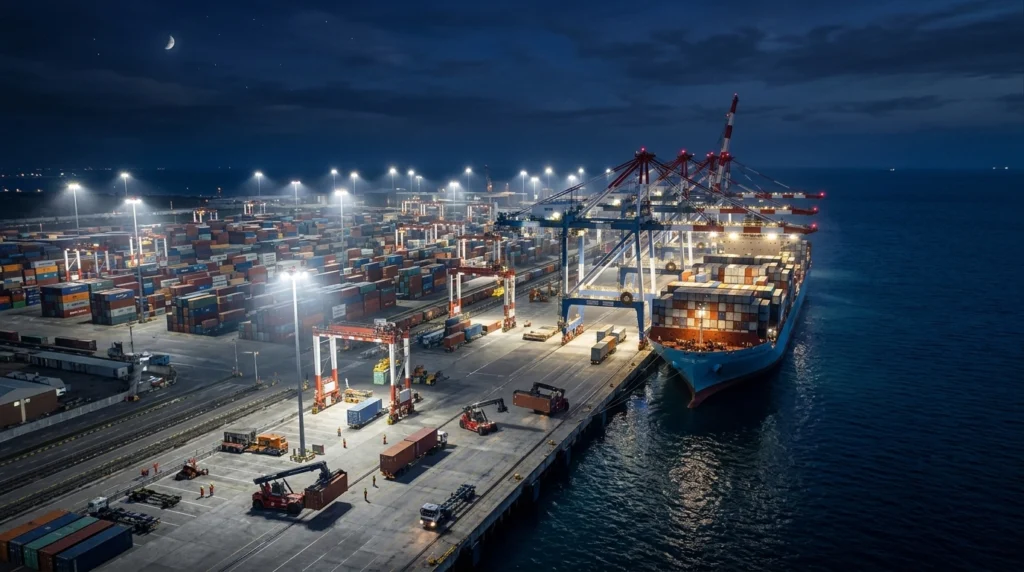
Introduction: The Vulnerability of India’s 7,500 km Industrial Shoreline
India’s coastal industrial zones – spanning critical major ports, petrochemical complexes, maritime fisheries infrastructure, and offshore fabrication yards represent some of the most capital-intensive built environments in the country. They are also, conversely, among the most structurally destructive operating environments for industrial electrical infrastructure. Salt-laden marine air, severe humidity cycling, aggressive chemical vapours, and continuous wind-driven particle impacts combine to degrade standard industrial luminaires completely within 36 to 60 months.
When procuring architectural assets for these sectors, choosing a product based solely on a high Ingress Protection (IP) rating is a guaranteed path to premature system failure. To survive the harsh maritime conditions of the Indian peninsula, a deeply engineered, marine-grade approach to coastal industrial LED lighting corrosion India parameters is mandatory. Here is the comprehensive technical breakdown of what true coastal specification requires.
THE PROBLEM: Understanding Coastal Industrial LED Lighting Corrosion India Failure Points
Salt air corrosion is not a gradual, linear degradation process; it is an aggressive, compounding electrochemical attack. Within a 100-meter to 500-meter zone of the Indian coastline, dissolved sodium chloride, magnesium chloride, and sulfate particles remain highly concentrated in the atmosphere throughout the year. Driven by strong marine winds, these hygroscopic particles deposit continuously onto the exposed metal surfaces, sealing gaskets, and electrical connection interfaces of outdoor industrial luminaires.
For standard die-cast aluminium LED fixtures even those proudly claiming a sealed IP66 or IP67 rating the failure mechanism works through three distinct, simultaneous structural pathways:
Pathway 1: Galvanic Corrosion Mechanisms
Standard industrial LED fixtures inherently utilize multiple dissimilar metals in their structural assembly. An ordinary fixture features a die-cast aluminium alloy housing, structural stainless steel fasteners, internal copper electrical terminals, and zinc-plated or phosphate-coated mild steel mounting brackets.
When combating coastal industrial LED lighting corrosion India factors, moisture laden with salt-water electrolytes settles into the joints where these metals interface, it completes an active galvanic circuit. The electrochemical potential difference triggers aggressive galvanic corrosion, where the less noble metal – the primary aluminium housing sacrifices itself. This manifests as severe surface pitting, white oxidation flaking, and total structural failure of the mounting mounts within 2 to 4 years of installation.
Pathway 2: Ingress Protection (IP) Gasket Degradation
Standard commercial outdoor fixtures rely on Ethylene Propylene Diene Monomer (EPDM) synthetic rubber gaskets to compress and form the primary IP66 moisture barrier between the housing components. However, coastal environments expose these polymers to high-intensity ultraviolet (UV) solar radiation, localized ozone from heavy port machinery, and extreme thermal expansion and contraction cycles as ambient temperatures shift from scorching tropical daytime highs to cool, humid marine nights. Under this sustained environmental stress, standard EPDM gaskets rapidly lose their elasticity, become brittle, develop micro-cracks, and fail to maintain a water-tight seal.
Pathway 3: PCB Track and Driver Board Delamination
Even if a luminaire’s outer housing shows minimal external damage, micro-scopic salt particles inevitably ingress during mandatory field maintenance or through poor cable connector installations. Once inside, these highly conductive, moisture-attracting salt crystals deposit directly onto printed circuit board (PCB) surfaces, exposed solder points, and LED driver terminals. As the relative humidity rises at night, these salt deposits liquefy, forming micro-bridges of electrical conductivity. This leads directly to track short-circuits, parasitic current leaks, and localized component blowouts making driver failure the most frequent cause of premature breakdown in coastal industrial sites.
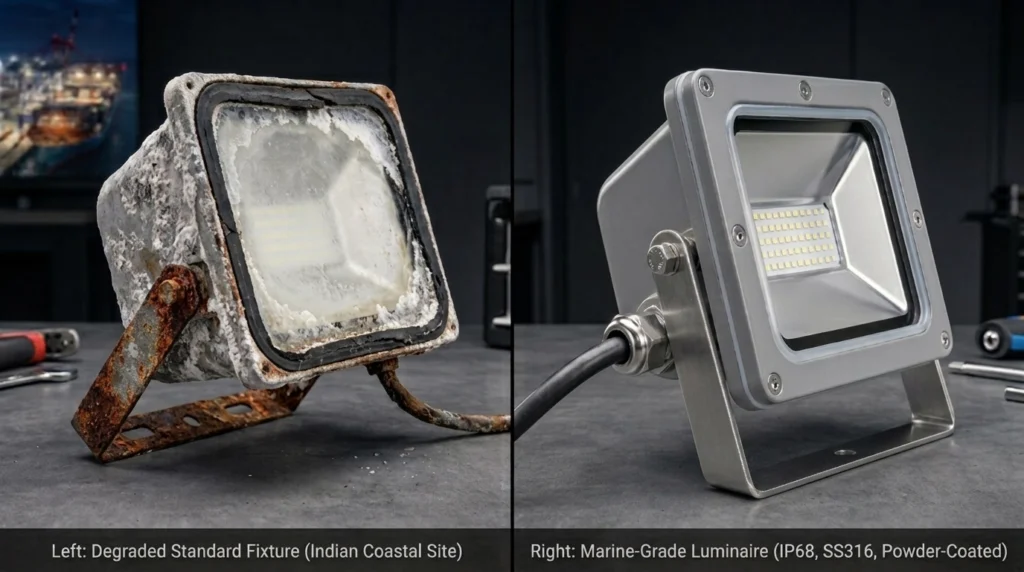
WHAT MARINE-GRADE ACTUALLY MEANS: Beyond Ingress Protection (IP66)
A common specification error across Indian infrastructure projects is assuming that an IP66 or IP67 rating automatically qualifies a fixture for maritime placement. In reality, an IP rating merely tests a brief resistance to water jets or temporary immersion; it says absolutely nothing about a material’s ability to withstand chemical oxidation, UV-driven degradation, or prolonged exposure to salt-spray fog. True marine-grade configuration requires meeting comprehensive material benchmarks.
Advanced Housing Chemistry and Protective Metallurgy
True marine-grade luminaires must be cast from specific, low-copper marine aluminium alloys (containing less than 0.1% copper content) to minimize internal galvanic activity. Before any external aesthetic coating is applied, the raw casting must undergo a multi-stage chemical pre-treatment, typically a chromate conversion coating or an anodizing surface passivation process.
Once passivated, the housing receives a high-build, specialized Triglycidyl Isocyanurate (TGIC) polyester powder coating. This coating must be cross-linked and baked to a minimum thickness of 100–120 microns, creating an impermeable barrier against acid-rain and saline moisture. To verify resistance against coastal industrial LED lighting corrosion India environments, specifications should demand certified testing showing a minimum of 1,000 to 3,000 hours of continuous salt spray exposure under the stringent ISO 9227 or ASTM B117 international protocols. For extreme zones like offshore chemical berths or high-acid petrochemical processing plants, moving away from alloys to Glass-Reinforced Polyester (GRP) or cast Grade 316 stainless steel housings is the definitive engineering standard.
Specialized Gasket Polymer Chemistry
To guarantee structural sealing and stop coastal industrial LED lighting corrosion India moisture ingress over a 10-year design life, high-performance fixtures swap out generic EPDM rubber for high-grade vulcanized silicone or fluorosilicone gaskets. Silicone compounds maintain excellent elastic memory across extreme temperature ranges -40 C to +200 C, show total immunity to intense UV radiation, and exhibit high resistance to atmospheric ozone degradation. For critical coastal infrastructure, employing a redundant double-gasket mechanical design—where an outer silicone seal blocks the bulk of the moisture and an inner secondary gasket provides backup airtight protection—is highly recommended.
Fastener, Gland, and Hardware Standardization
Every single external screw, bolt, washer, and retaining clip on a coastal luminaire must be explicitly specified as Grade 316 Stainless Steel (SS316). Lower grades like SS304 or zinc-plated carbon steel fail rapidly when subjected to salt spray. Furthermore, structural mounting brackets must be manufactured from thick, hot-dip galvanized structural steel (>85 microns zinc coating depth) or solid SS316. Cable entry points must utilize heavy-duty IP68 marine polyamide or nickel-plated brass liquid-tight cable glands to prevent water tracking along wire jackets into the enclosure terminal block.
Engineering Specifications Matrix: Industrial vs. Coastal Marine
| Component / Parameter | Standard Inland Industrial | Coastal Minimum Requirement | Offshore / Severe Chemical Zone |
| Housing Material | Standard Die-Cast Aluminium | Low-Copper Alloy + TGIC Powder Coat | Solid Grade 316 Stainless Steel / GRP |
| Ingress Protection | IP65 | IP66 / IP67 Redundant Seal | IP67 / IP68 Continuous Immersion |
| Gasket Elastomer | Commercial EPDM Rubber | High-Grade UV-Stabilized Silicone | Double-Lip Vulcanized Silicone |
| External Fasteners | Zinc-Plated Carbon Steel | Grade 316 Marine Stainless Steel | Grade 316 Stainless Steel Only |
| Cable Gland Entry | Standard Molded Polyamide | IP68 Marine Liquid-Tight Nylon | IP68 Heavy Nickel-Plated Brass / SS316 |
| Mounting Hardware | Electro-Galvanized Mild Steel | Hot-Dip Galvanized (>85μm) or SS316 | Solid Structural SS316 Plates Only |
| Salt Spray Rating | No Standard Testing | Minimum 1,000 Hours (ISO 9227) | 3,000+ Hours Marine Certified |
ELECTRICAL ENGINEERING: Solving Coastal Industrial LED Lighting Corrosion India Electrical Surges
Beyond structural breakdown, solving coastal industrial LED lighting corrosion India challenges means addressing volatile electrical supply patterns that drastically stress solid-state LED systems. Heavy industrial ports operating large ship-to-shore container cranes, rail yards, and heavy-duty conveyor systems constantly inject massive high-frequency electrical harmonics back into the local distribution grid. Additionally, processing plants utilizing large generator backup arrays introduce intense switching transients during routine power handovers. Compounding this, saline moisture tracking along external cables regularly causes low-level earth leakage faults.
To isolate delicate LED chips from these severe transient spikes, drivers specified for coastal industrial LED lighting corrosion India environments must incorporate heavy-duty internal and external surge protection devices (SPDs) providing a minimum of 10KV / 10kA (and ideally 20KV) of surge suppression.
Furthermore, the driver must never share a common air cavity with the optical LED board. High-end fixtures utilize a isolated dual-compartment mechanical design. The driver is sealed independently within its own cast electrical box, meaning that even during routine field wire terminations, the primary optical engine and driver electronics remain perfectly isolated from ambient humidity and dust ingress.
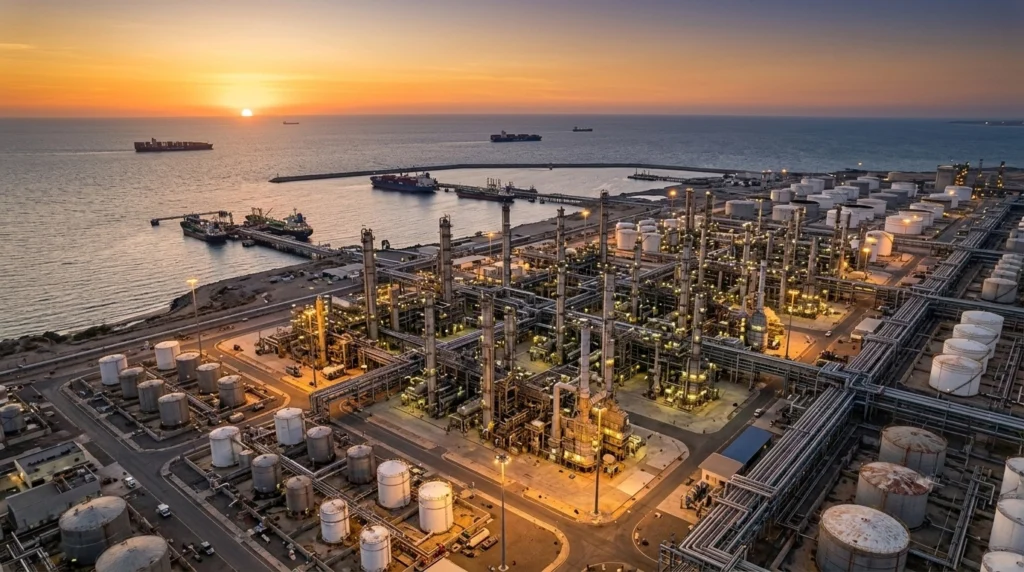
APPLICATION MAP: Geographic Corrosion Zonation for Indian Infrastructure
The real-world intensity of coastal industrial LED lighting corrosion India factors scales directly based on proximity to the breaking surf. Procurement teams should map their engineering specifications using this geographic distance matrix:
- Major Port Container Terminals & Jetties (0 to 200m): Subject to high wind loads and direct risk of coastal industrial LED lighting corrosion India structural damage, and wave impact. Recommended: Full Offshore / Chemical Grade (SS316/GRP or passivated alloy with >3,000-hr salt-spray rating).
- Coastal Petrochemical Processing Plants (0 to 500m): Combined threat of marine salt aerosol and corrosive chemical process vapors (H2S, SO2). Recommended: Explosion-Proof, Chemical-Grade Ex-certified marine fixtures with double-silicone seals.
- Coastal Highways & Maritime Logistics Yards (0 to 1km): High ambient humidity mixed with industrial vehicle exhaust soot. Recommended: Coastal Industrial Minimum (TGIC multi-layer powder coating, SS316 hardware, IP66).
- Port Warehousing & Free-Trade Logistics Hubs (500m to 2km): Internal high-humidity condensation inside non-air-conditioned steel structural warehouses. Recommended: High-bay fixtures with treated aluminum heatsinks, IP66 protection, and silicone gaskets.
KEY TAKEAWAYS FOR INFRASTRUCTURE PROCUREMENT
- IP66 Is Only Half the Battle: An ingress rating stops water entry but does not prevent chemical corrosion of the underlying metals. Always specify the base alloy and coating chemistry.
- Demand Certified ISO 9227 Compliance: Never accept vague marketing terms like “corrosion-resistant.” Require third-party testing proving a minimum of 1,000 hours of salt spray exposure.
- Eliminate Galvanic Pairs: Ensure all external hardware components use matching Grade 316 stainless steel to eliminate electrochemical degradation pathways.
- Insist on Isolated Driver Compartments: Isolate electrical drivers from ambient air during maintenance to dramatically reduce tracking-current failure modes.
- Leverage Local Indian Engineering Expertise: Leoforse designs, tests, and builds high-mast, flood, and high-bay fixtures tailored exactly to the high-humidity, high-salinity profiles of Indian industrial coastlines.
CONCLUSION
Failing to fully account for coastal industrial LED lighting corrosion India frameworks across infrastructure sectors carries a steep, highly predictable financial penalty. Fixtures engineered to last 12 years in a dry, inland manufacturing facility are routinely destroyed in under 3 years when deployed along high-salinity coastlines – not because LED technology failed, but because the wrong structural wrapper was specified for the environment.
Marine-grade modification is not an optional premium add-on; it is the fundamental baseline requirement for any infrastructure asset operating within meaningful distance of India’s shoreline. By mandating rigorous material testing, advanced TGIC coatings, silicone gaskets, and heavy-duty 10KV surge protection, operators safeguard their investments, maximize uptime, and eliminate recurring maintenance cash drains.
The engineering team at Leoforse is fully equipped to conduct site-specific environmental stress audits, advanced photometric layout simulations, and structural wind-load calculations for your coastal installations.
OVER TO YOU
Is your current asset or facility located along India’s coastline? What has been your historical breakdown rate with standard LED fixtures? Share your exact location, distance from the sea, and operating environment parameters in the comments section below – our technical engineering team responds directly to every site inquiry.
FAQ: Coastal LED Lighting – Technical Quick Answers
Q: How close to the shoreline does full marine-grade specification apply?
A: Within 0 to 200 meters of the breaking surf, full marine-grade specification is strictly required due to direct salt spray. From 200 meters to 1 kilometer, enhanced coastal specifications (TGIC powder coat, silicone gaskets, SS316 fasteners) are highly recommended. For sites between 1 and 3 kilometers inland in highly humid zones, upgraded surface passivation should still be implemented.
Q: What is the operational difference between an IP66 and an IP68 rating?
A: An IP66 rating certifies that the fixture can withstand powerful high-pressure water jets from any angle without taking on water. An IP68 rating certifies that the luminaire can withstand complete, continuous submersion in water under pressure. IP68 is typically mandatory for low-lying cable junction boxes, underground distribution pits, or flood-prone marine berths.
Q: Can standard fixtures already deployed at a coastal site be coated or upgraded retroactively?
A: No. Once galvanic pitting and oxidation have initiated within an aluminum housing matrix, the chemical reaction cannot be reversed or halted with an external spray. Furthermore, replacing old gaskets with silicone in the field is not cost-effective. The correct approach is a systematic, phased replacement program utilizing true marine-grade alternatives, focusing on the highest-exposure zones first.
Q: Does Leoforse provide certified marine-grade fixtures for heavy-use port installations?
A: Yes. The Leoforse industrial catalog includes high-output floodlights, high-bays, and high-mast infrastructure fixtures specifically customized with multi-layer TGIC powder coats, solid silicone gasketing, marine-grade SS316 fasteners, and 10KV/10kA surge isolation. Custom material setups for highly aggressive offshore chemical zones are available upon project request.
Protect Your Coastal Investment : Specify Right from the Start !
The Leoforse engineering division is available to audit your facility conditions and deliver a certified coastal or marine-grade layout package—complete with photometric plans, structural recommendations, and exact bill-of-materials.
- 🌐 Request Technical Coastal Consultation:
https://leoforse.com/contact-us - 💬 Connect Directly via WhatsApp:
+91 95005 78101 - ✉️ Email Our Procurement Desk:
salesleoforseled@gmail.com
0 Comments