When it comes to LED lighting stadiums hospitals smart cities India, the story isn’t just about energy savings; it’s about precision engineering for high-stakes environments. There is a version of the LED lighting story that never gets old: a factory replaces old technology with high-efficiency LEDs, energy bills drop, and everyone goes home happy. It is a true story. It has been told well.
But it is only the beginning of the story.
The more interesting version – the one being written right now across India’s infrastructure landscape – is about precision LED engineering applied to environments where the stakes of getting it wrong are far higher than an elevated electricity bill. A stadium where broadcast-quality flicker-free illumination is the difference between a world-class event and an embarrassing technical failure. A pharmaceutical clean room where the wrong light fitting is a contamination risk. A municipal road project where solar-powered LED street lighting extends safe mobility to communities three hours from the nearest power grid. A commercial tower where architectural lighting defines the entire brand identity of the building.
This is the future of LED lighting stadiums hospitals smart cities India, a story of engineering that deserves telling in 2026.
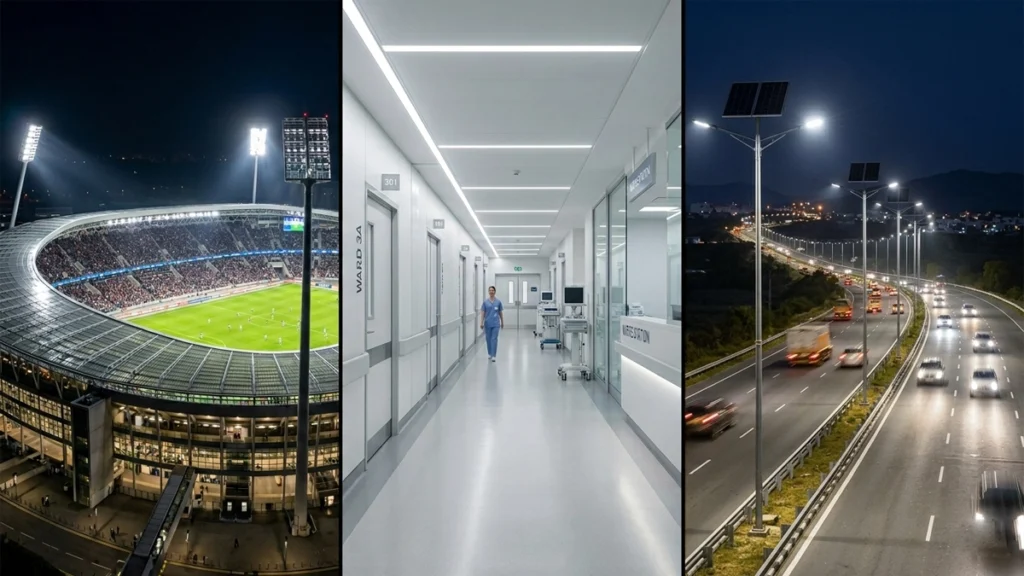
Precision LED lighting stadiums hospitals smart cities India: A Focus on Sports
Stadium lighting in India is no longer limited to national cricket grounds and metro football arenas. India’s sports infrastructure push – covering district-level sports complexes, university athletic facilities, multi-sport township developments, and the growing ecosystem of professional sports leagues – has created significant demand for broadcast and performance-grade outdoor stadium lighting.
Flicker-Free Performance for Broadcasting
Modern sports broadcasting, including smartphone and DSLR cameras used in live streaming, operates at shutter speeds that can reveal flicker in low-quality LED systems. Flicker frequency at or above 3000Hz eliminates visible strobing in slow-motion replay and broadcast footage. For any stadium intending to host recorded or live-streamed events, flicker-free specification is non-negotiable.
Horizontal and Vertical Illuminance
Sports lighting requires both horizontal and vertical illuminance – because cameras, players, and spectators view action at multiple angles. A football pitch that reads 500 lux horizontally but only 200 lux vertically will look dim and uneven on broadcast footage.
Balancing these technical requirements is what defines high-standard LED lighting stadiums hospitals smart cities India projects.
Uniformity Across the Playing Surface
For most sports governing bodies and broadcasting standards, uniformity ratios on playing surfaces are tightly specified. Achieving these levels in an outdoor stadium environment demands careful photometric planning – where fixture positions are constrained by structural geometry and spill light control is important to avoid glare for players and spectators.
Hospitals and Healthcare: Light as a Clinical Tool
When implementing LED lighting stadiums hospitals smart cities India, healthcare environments represent the most rigorous technical challenge, sitting at the intersection of compliance and care. It is one of the most technically nuanced lighting applications in the built environment – and one where the consequences of specification failures extend beyond financial cost.
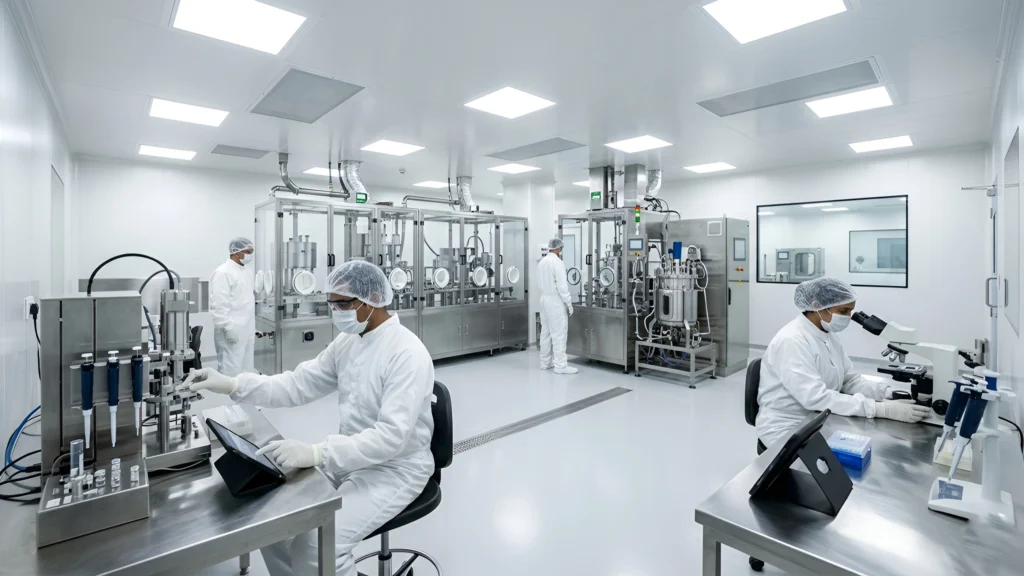
Clean Room and Operating Theatre Panels
Pharmaceutical manufacturing clean rooms and hospital operating theatres operate under strict hygiene and contamination control protocols. Lighting fixtures in these environments must eliminate dust accumulation points, withstand cleaning chemical exposure, and maintain hermetic integrity against particle ingress. Stainless steel or powder-coated frames, back-lit LED panel designs, and IP54 or higher ratings are standard requirements.
Flicker performance in surgical environments is critically important. Surgeons operating under flickering artificial light experience eye fatigue and reduced visual acuity – which is why medical-grade LED panels specify very low flicker index values and CRI ratings above 90.
Ward and Patient Area Lighting
Evidence-based healthcare design has established clear relationships between lighting quality, patient recovery rates, and staff performance. Circadian rhythm-supportive lighting – which adjusts colour temperature across the day to support natural sleep-wake cycles – is increasingly specified in new hospital ward designs. Tunable white LED systems with DALI control integration support this application without expensive luminaire replacement.
Solar Street Lighting: Energy Access as Infrastructure
India’s solar street lighting market has matured significantly. The early generation of solar street lights has given way to genuinely infrastructure-grade solar LED systems capable of reliable all-night illumination in a wide range of Indian climatic conditions.
Battery Technology and Cycle Life
Lithium iron phosphate (LiFePO4) batteries have become the preferred chemistry for infrastructure-grade solar street lights in India. Compared to lead-acid alternatives, they offer longer cycle life, better depth of discharge tolerance, lower self-discharge rates, and better performance across temperature ranges. For installations targeting 10+ year operational lifespans, lithium battery chemistry is the correct engineering choice.
Smart Solar Controls
Modern solar street lights increasingly incorporate adaptive dimming – running at full output during peak evening hours and reducing to maintenance level in the early morning hours when traffic is minimal. This extends battery autonomy, reduces degradation cycles, and allows the system to handle cloudy day periods without complete output failure. These intelligent systems are the backbone of sustainable LED lighting stadiums hospitals smart cities India initiatives
Commercial and Architectural Lighting: Where Engineering Meets Aesthetics
For LEED-rated or GRIHA-rated green buildings – increasingly the standard for new commercial developments in India – lighting power density (LPD) compliance is a formal requirement. High-efficacy LED panels with DALI dimming and occupancy sensor integration directly support LPD targets.
Commercial buildings in India’s growing real estate market increasingly use LED facade lighting as a branding and identity tool. Programmable RGB or tunable white systems on building exteriors, combined with architectural downlights and linear cove lighting in lobbies, create the premium visual character that drives occupancy and rental premium in competitive markets.
High-Mast and Outdoor Infrastructure: Lighting India’s Public Spaces
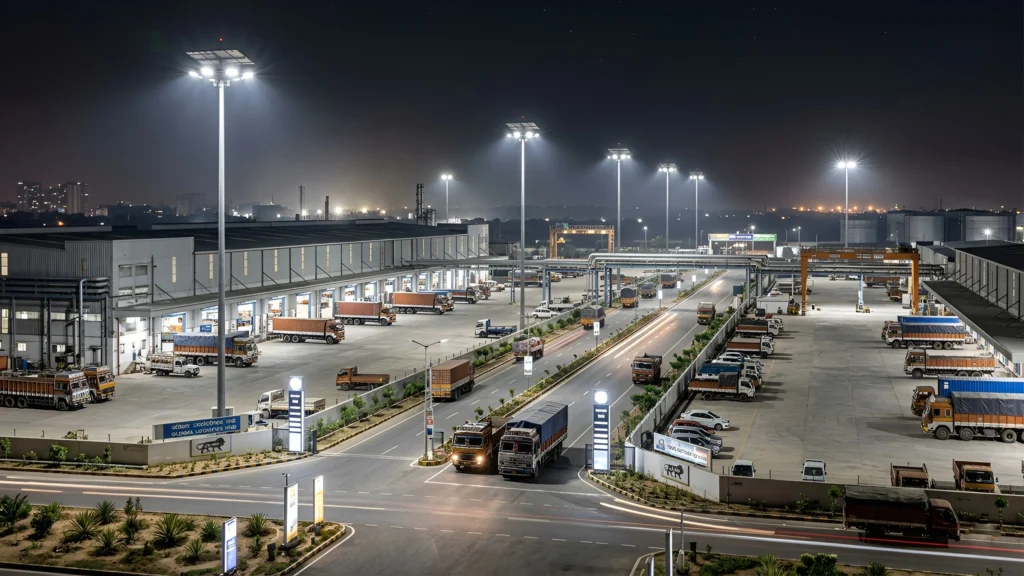
High-mast lighting – poles of 15m to 45m height carrying multiple high-wattage LED floodlights – is the lighting technology of airports, expressways, industrial zones, ports, and large public spaces.
For expressways, uniform illuminance across multiple lanes at high horizontal distances from the mast demands wide asymmetric beam optics. For industrial yards and port container handling areas, broad symmetric distribution that eliminates shadows between stacked containers is the photometric requirement. Getting this right requires the same photometric-first approach as any other engineered lighting application.
Expert FAQ Section
| Q: What flicker specification should I require for a stadium or sports facility LED system? | For broadcast-compatible stadium lighting, specify luminaires with flicker frequency above 3000Hz and a flicker index below 0.1. For general recreational facilities without broadcast requirements, low flicker is still preferable for visual comfort, particularly in ball sports where strobing at certain frequencies can distort the apparent trajectory of fast-moving objects. |
| Q: What CRI is required for hospital and pharmaceutical lighting? | Hospital operating theatres and clinical examination areas require CRI of 90 or above. General ward and corridor lighting is typically specified at CRI 80+. Colour temperature is typically 4000K for clinical areas, with warmer options for patient recovery rooms. |
| Q: How long does a solar street light system last in Indian conditions? | A well-specified solar street light system with LiFePO4 batteries and quality LED fixtures should achieve 8–12 years of operational life in Indian conditions with standard maintenance. Battery pack replacement at approximately year 8–10 is the primary life-cycle cost item. |
| Q: What is DALI lighting control and when is it relevant for commercial projects? | DALI (Digital Addressable Lighting Interface) is a two-way digital control protocol for LED luminaires that enables individual or group dimming, scene setting, and energy monitoring. It is relevant for commercial projects targeting LEED or GRIHA ratings, facilities with daylight harvesting requirements, and any large commercial space where granular lighting control and energy logging is specified. |
| Q: Can LED floodlights be used for high-mast applications? | High-mast applications require luminaires specifically designed for the purpose – with appropriate asymmetric or symmetric beam distributions, structurally rated housings for wind loading, and lumen output sufficient to achieve the required horizontal illuminance from 20m+ mounting heights. Standard commercial floodlights are not appropriate for high-mast applications. |
The Infrastructure Lighting Partner of Choice
These intelligent systems are the backbone of sustainable LED lighting stadiums hospitals smart cities India initiatives. It is a manufacturing and engineering partner – building in Puducherry, serving infrastructure projects across India – with the technical depth to serve applications from pharmaceutical clean rooms to outdoor stadiums, from solar streets in Tier-3 municipalities to LED facades on premium commercial towers.
Every application is different. Every application deserves engineering, not guesswork.
One Infrastructure Partner. Every Application!
From a pharmaceutical clean room in Chennai to a solar-lit ring road in a Tier-2 district, Leoforse has the engineering capability to deliver the right light for every environment.
🌐 Explore Products & Applications
📞 Contact Engineering Expert: +91 95005 78101
0 Comments