
WHY STANDARD LEDS FAIL IN COLD ENVIRONMENTS
Designing cold storage LED lighting India facilities requires solving three unique thermal and moisture challenges that standard indoor fixtures simply cannot handle. An LED luminaire that has been tested and rated in a standard laboratory environment at 25°C ambient has not been tested for what happens when it is installed in a cold room operating at -5°C, -18°C, or -25°C. The physics change. The components behave differently. And the failure modes are predictable, if you know what to look for.
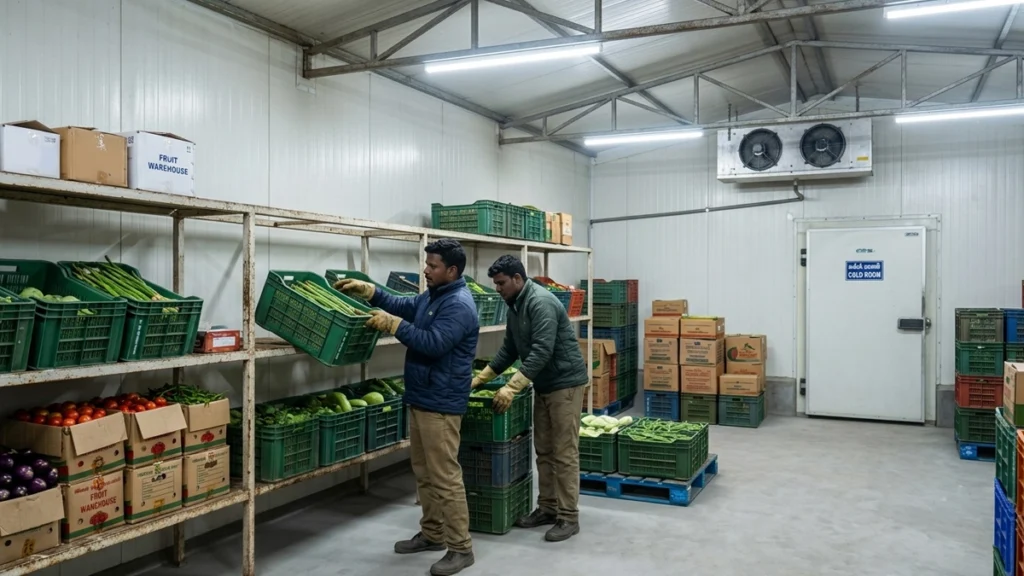
Selecting the right cold storage LED lighting in India starts with understanding these three failure points, that standard industrial LED products are not designed to handle.
| -25°C Typical Blast Freezer Operating Temperature | IP66 Minimum Rating for Washdown Cold Rooms | 10KV Surge Protection Standard – Leoforse Drivers |
WHY STANDARD LEDS FAIL IN COLD ENVIRONMENTS
The LED driver – the electronic component that converts AC power to regulated DC current for the LED modules uses electrolytic capacitors as a core component. These capacitors rely on a liquid electrolyte that becomes viscous and less efficient at very low temperatures.
In a -18°C cold room, a driver that uses standard electrolytic capacitors will take significantly longer to reach stable operating current after switch-on. In extreme cases, the driver may fail to start entirely in very low ambient conditions, or output unstable current that causes visible flicker until the driver warms up.
| ENGINEERING REQUIREMENT: For cold storage applications, specify LED drivers rated for low-temperature startup typically rated to -20°C or -30°C ambient. Drivers using film capacitors or hybrid capacitor designs instead of standard electrolytic capacitors offer more reliable cold-start performance. Always check the driver datasheet for the minimum operating temperature specification, not just the luminaire housing rating. |
CHALLENGE 2: CONDENSATION AND INGRESS
Cold storage facilities are not permanently cold in all zones. Loading docks, staging areas, and anteroom environments cycle between cold and ambient temperatures multiple times per day. Every thermal cycle creates a condensation event moisture forms on every surface that transitions from cold to warm.
For LED luminaires, this condensation cycle is particularly damaging. Moisture that forms on the outer housing migrates toward any imperfection in the IP gasket seal.
Over repeated cycles, even a well-rated IP65 fixture can allow moisture ingress if the gasket material has degraded or if the fixture design has not accounted for the pressure differential that temperature changes create inside the housing. For cold storage LED lighting India projects, IP rating is the most critical specification after driver temperature rating.
What IP Rating Is Actually Required
| Zone Type | Environment | Minimum IP Rating | Recommended |
| Blast freezer / frozen storage | -18°C to -25°C, dry | IP65 | IP66 |
| Chiller room | 0°C to 8°C, moderate humidity | IP65 | IP66 |
| Washdown food processing | Wet, chemical cleaning agents | IP66 | IP66 + corrosion-resistant housing |
| Loading dock / anteroom | Thermal cycling, humidity | IP65 | IP66 |
| Dry cold storage | Ambient to -10°C, low humidity | IP54 | IP65 |
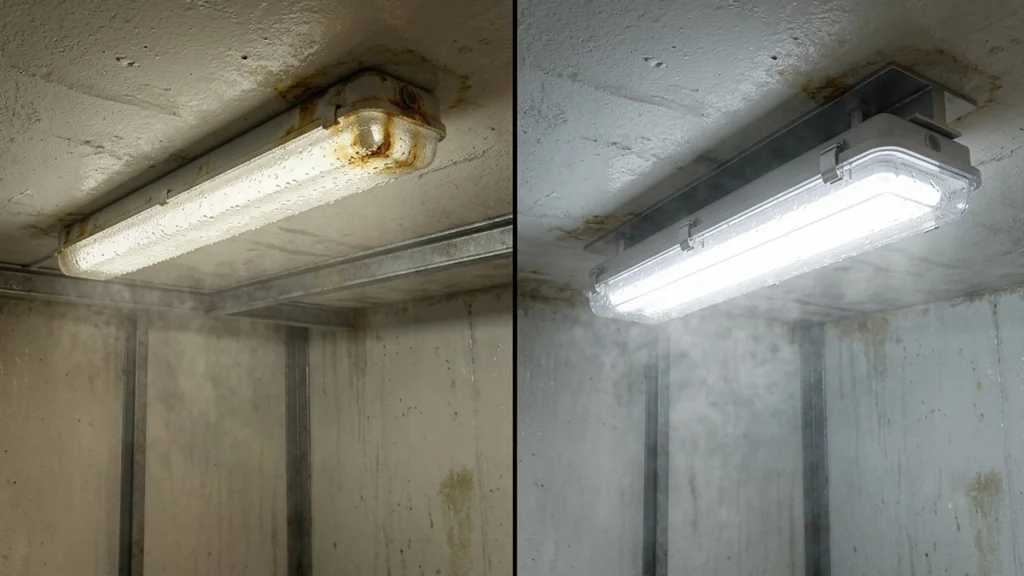
CHALLENGE 3: WASHDOWN AND CHEMICAL EXPOSURE
Food processing environments operate under strict hygiene protocols that require regular washdown with cleaning agents, disinfectants, and in some facilities, acidic or alkaline cleaning solutions.
The luminaire housing, diffuser, gasket, and mounting hardware are all exposed to these chemicals repeatedly over the facility’s operational life.
Standard powder-coated aluminium housings are not designed for repeated exposure to food-grade cleaning chemicals. The coating can degrade, exposing the aluminium substrate to chemical attack and corrosion. In regulated food processing environments, fixture contamination – whether from corroding housing material or a compromised diffuser – is a compliance issue, not just a maintenance issue.
Housing Material Requirements for Food Processing Zones
For wet food processing environments with chemical washdown, specify luminaires with one of the following housing approaches:
- Polycarbonate or reinforced plastic housing – chemically inert, no corrosion risk, food-safe material
- Marine-grade aluminium alloy with TGIC polyester powder coating – rated for chemical exposure
- Stainless steel housing – for the most aggressive chemical environments or pharmaceutical production
- Sealed polycarbonate diffuser – one-piece moulded, no joints or seams on the light-emitting face
LUX REQUIREMENTS FOR COLD CHAIN APPLICATIONS
Lux requirements for cold storage LED lighting India installations and food processing environments are governed by both operational need and regulatory guidance. “The Bureau of Indian Standards publishes IS 3646 (Code of Practice for Interior Illumination) which provides the recommended illuminance levels for industrial and storage spaces in India — the lux figures in the table below are aligned with these guidelines.” Workers operating in low-temperature environments with heavy clothing and gloves require clear, well-distributed illumination for safe material handling and quality checks.
| Zone | Recommended Lux | Uniformity | Notes |
| Blast freezer interior | 150–200 lux | ≥ 0.6 | Low activity storage only |
| Chiller room — picking | 200–300 lux | ≥ 0.6 | Barcode reading, label inspection |
| Food processing line | 300–500 lux | ≥ 0.7 | Quality inspection, hygiene critical |
| Packaging and labelling | 400–500 lux | ≥ 0.7 | Fine detail work |
| Loading dock | 150–250 lux | ≥ 0.6 | Vehicle movement, pallet handling |
| Cold room corridor | 100–150 lux | ≥ 0.6 | Circulation only |
THE FULL SPECIFICATION FRAMEWORK
Cold Storage LED Specification Checklist for Indian Facilities
Before procuring cold storage LED lighting India solutions for any food processing or pharmaceutical facility, your specification document should capture:
- Minimum operating temperature of driver – must match or exceed the coldest zone temperature
- IP rating verified for both static cold and thermal cycling conditions – not just static IP test
- Housing material compatibility with washdown chemicals used in that specific facility
- Diffuser material – polycarbonate preferred over PMMA acrylic for impact and cold resistance
- Gasket material – silicone preferred over EPDM for low-temperature flexibility
- Surge protection rating – 6KV minimum, 10KV for facilities with refrigeration compressor banks
- Lux level and uniformity verified by Dialux simulation before procurement
- Mounting configuration – surface or recessed – appropriate for ceiling type and washdown access
| LEOFORSE ENGINEERING NOTE: Leoforse provides complete photometric simulation services – Dialux lux layouts, IES file support, and zone-by-zone specification guidance – for cold storage and food processing facility projects at no charge. Contact the engineering team before procurement to confirm the right product for your specific zone temperatures and cleaning protocols. |
KEY TAKEAWAYS
- Standard industrial LEDs are not engineered for sub-zero environments – driver cold-start rating and capacitor type are the critical parameters to check.
- IP66 is the minimum specification for cold rooms with humidity cycling. IP65 is insufficient for washdown food processing environments.
- Housing material must be compatible with the specific cleaning chemicals used – standard powder coat is not rated for repeated food-grade chemical exposure.
- Lux requirements in cold chain facilities range from 150 lux in static frozen storage to 500 lux on food processing inspection lines.
- Surge protection of 6KV–10KV is required where large refrigeration compressor banks are on the same electrical feeder.
CONCLUSION
The cold storage LED lighting India market is one of the fastest-growing segments of the country’s industrial construction sector. Pharmaceutical logistics, food processing, frozen goods distribution, and temperature-controlled e-commerce fulfilment are all driving significant investment in new cold storage facilities. The lighting inside these facilities deserves the same engineering rigour as the refrigeration systems, the insulated panels, and the hygiene protocols. A standard industrial LED installed in a -18°C blast freezer or a food-grade washdown environment will fail predictably – not because LED technology is inadequate, but because the wrong product was specified for the environment. Leoforse engineers are available to assess your specific cold chain zones, confirm the right driver temperature rating, IP specification, and housing material, and provide a complete Dialux lux layout before your procurement is finalised.
OVER TO YOU!
Are you building or upgrading a cold storage or food processing facility in India? What is the lowest operating temperature in your facility and what lighting are you currently running? Comment below.
Comment below – our engineering team replies to every question.
FAQ: Cold Storage LED Lighting | Quick Answers
Q What is the minimum driver temperature rating for a cold room LED?
The driver minimum operating temperature must be equal to or lower than the coldest ambient temperature in the zone where it is installed. For chiller rooms (0°C to 8°C), a driver rated to -10°C is sufficient. For blast freezers operating at -18°C to -25°C, specify a driver rated to -30°C minimum. Always check the driver datasheet – not just the luminaire housing specification. This is the most under-checked specification in cold storage LED lighting India procurement projects.
Q Can I use a standard IP65 LED in a food processing washdown environment?
IP65 provides protection against low-pressure water jets from any direction. Food processing washdown typically uses high-pressure hoses and chemical cleaning agents – which require IP66 as a minimum. For facilities using acidic or alkaline cleaners, housing material compatibility is equally important. Confirm both IP rating and housing chemical resistance with your supplier before procurement.
Q Why do LEDs flicker in cold storage facilities after switch-on?
Flickering after cold-start is typically caused by LED drivers using standard electrolytic capacitors that become sluggish at low temperatures, causing unstable output current during the warm-up period. Specifying drivers rated for low-temperature startup – and using film or hybrid capacitor designs – eliminates this behaviour. If flickering continues beyond 2–3 minutes of operation, the driver may be under-rated for the operating temperature.
Q What lux level is required for a food processing inspection line?
Tell Leoforse your zone temperatures, floor area, and cleaning protocols. The engineering team will confirm the correct driver rating, IP specification, and housing material – and deliver a Dialux lux layout within 48 hours.
Food processing lines where workers inspect product quality, check labels, or perform manual sorting and packaging typically require 400–500 lux on the working plane, with a uniformity ratio of 0.7 or above. This is significantly higher than general cold storage (150–200 lux) and requires a specific photometric layout to achieve without over-specifying wattage in low-activity zones.
Specify the Right LED for Your Cold Storage Facility
Tell Leoforse your zone temperatures, floor area, and cleaning protocols. The engineering team will confirm the correct driver rating, IP specification, and housing material – and deliver a Dialux lux layout within 48 hours.
- 🌐 Request Technical Coastal Consultation:
https://leoforse.com/contact-us - 💬 Connect Directly via WhatsApp:
+91 95005 78101 - ✉️ Email Our Procurement Desk:
salesleoforseled@gmail.com
0 Comments